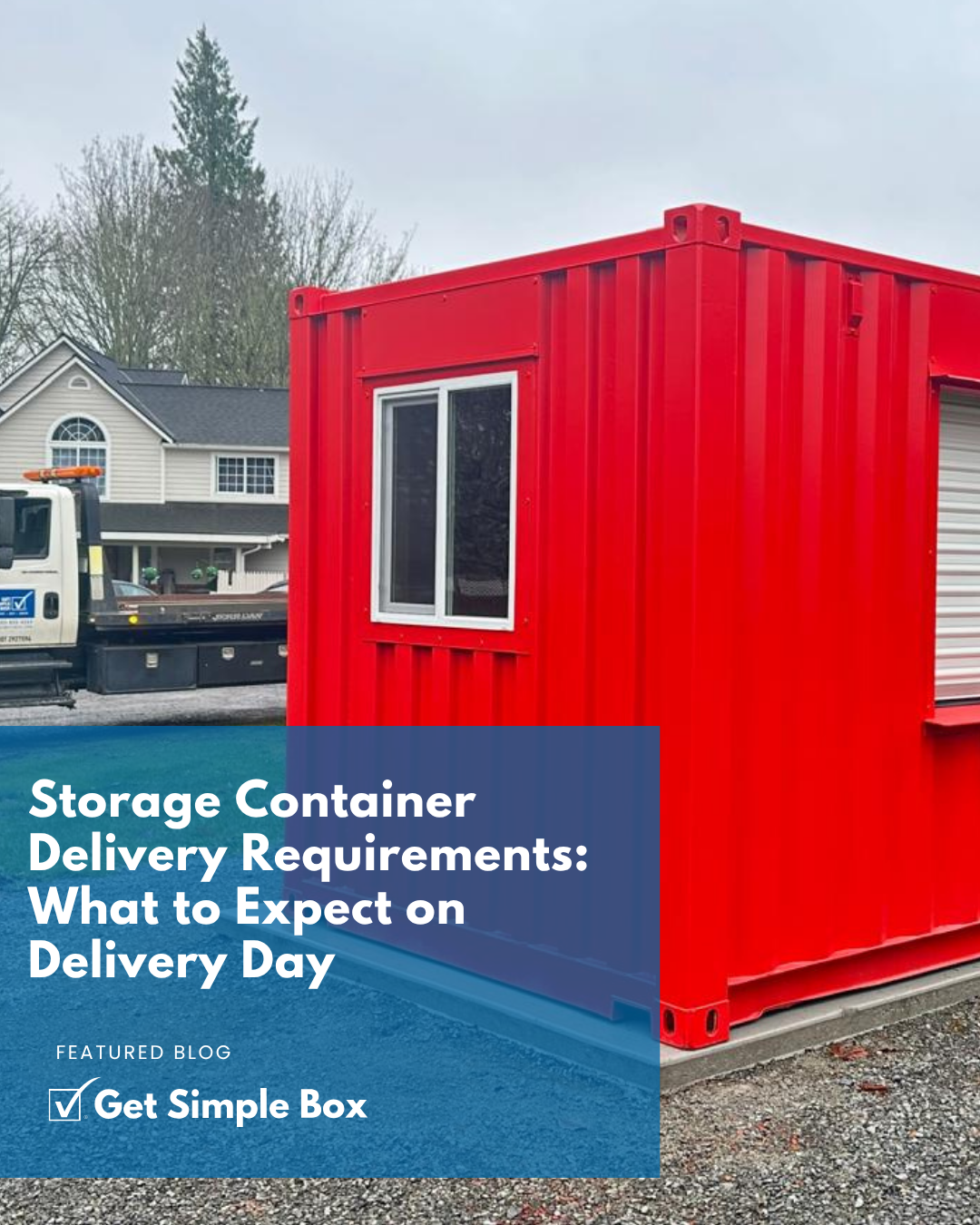
Storage Container Delivery Requirements: What to Expect on Delivery Day
Quick Summary:
Understanding key storage container delivery requirements is the best way to ensure a calm, predictable placement. Preparing your site requires checking your driveway’s shipping container clearance space, understanding doors to the rear vs doors to the cab orientation before loading, and protecting your pavement from concentrated corner casting weight. Get Simple Box uses specialized tilt-bed trucks and trained local drivers, never outside subcontractors, to place your 10ft, 20ft, or 40ft container safely.
Can You Put a Storage Container in Your Driveway?
Quick Answer: Yes, you can put a storage container in most driveways. However, our drivers look at the whole picture, including driveway length, ground slope, and turn obstacles, to meet all storage container delivery requirements without scraping asphalt or damaging your property.
When you’re remodeling a kitchen, decluttering for a move, or staging a job site, bringing a heavy steel box onto your property can feel intimidating. Will it fit? Will it crack the concrete? How will a big truck maneuver into place?
We also recommend checking with your local Homeowners Association (HOA) or city permit office before delivery day. Some gated communities or neighborhoods have specific rules about how long a container can sit on a driveway or where it can be placed.
At Get Simple Box, we deliver peace of mind. Following a clear storage container driveway placement guide turns what could be a stressful delivery into a smooth hand-off.
Video Guide: Can You Put a Container in Your Driveway?
Key Video Takeaways:
- Check the Approach: Our drivers evaluate the entire path from the road to ensure there is enough straight-line space to back the truck in and pull forward smoothly.
- Can You Put a Shipping Container on a Steep Driveway? Driveways don’t need to be perfectly flat, but steeper slopes make placement trickier. The steeper the incline, the higher the risk of scraping the driveway or putting the truck in an awkward position.
- Watch for Obstacles: Trees, low roofs, fences, and sharp turns can block a large truck from maneuvering into position.
Space Requirements: Straight-Line Clearance, Width & Height
Knowing how much space you need for a 20ft container delivery comes down to three numbers: 70 feet of straight-line clearance, 10 feet of width, and 14 feet of vertical overhead height.
Meeting physical shipping container clearance space guidelines depends on the size of your container and the length of our tilt-bed delivery trucks. Always measure your placement zone before delivery day:
|
Container Size
|
Straight-Line Clearance Needed
|
Width Clearance
|
Overhead Vertical Clearance
|
|
10ft Container
|
Approximately 60 ft
|
10 ft
|
14 ft
|
|
20ft Container
|
Approximately 70 ft
|
10 ft
|
14 ft
|
|
40ft Container
|
Approximately 120–140 ft
|
10 ft
|
14–16 ft
|
Note: These are general guidelines. Actual space needs can vary based on ground slope, turning radius, and street access.
Site Surface Prep & Corner Casting Weight Physics
Containers must sit on a firm, stable surface like compacted gravel, asphalt, or concrete. An empty 20ft container weighs about 4,800 lbs, and a 40ft container weighs around 8,000 lbs, with all that weight resting entirely on four small corner points.
Understanding shipping container weight corner castings is crucial when preparing your site for a container delivery. A container’s structural weight isn’t spread evenly across its flat floor; it rests entirely on its four heavy steel corner castings:
How to Protect Driveway Container Delivery Sites:
- Choose a Firm Foundation: Set your container on concrete, asphalt, or packed gravel. Avoid soft lawn grass, mud, or uncompacted dirt where corner castings can sink.
- Lay Down Wood Blocks: To protect driveway container delivery surfaces (especially exposed aggregate or hot asphalt), lay down 2×6 wood planks (dunnage) or 4×4 blocks directly under the corner castings. This spreads out the weight and prevents scraping.
- Think Year-Round: Consider how rain, snow, mud, and seasonal thaw will affect your ground over the weeks or months your box sits on site.
- Keep Doors Level: Placing wood blocks under corner castings keeps the unit slightly off the ground, aiding drainage and ensuring doors align properly without sticking.
Door Direction Logistics: Doors to Rear vs. Doors to Cab
Understanding doors to the rear vs. doors to the cab before your container leaves our yard is essential because it determines how you immediately access your container the moment it is set down.
Because of how our specialized tilt-bed trucks operate, the driver backs into position and lowers the container down one end at a time. The truck cannot turn the container around once it arrives at your property, so we must load it onto the tilt-bed facing the correct direction at our local yard:
- DOORS TO THE CAB (Doors Unload Last): The container is loaded onto the truck with its doors facing forward toward the truck cab. As the driver backs into your driveway and tilts the bed, the solid back wall of the container touches the ground first. The truck then pulls forward, leaving the doors at the front end, meaning you can walk right up and open your container immediately from the street or driveway approach without walking all the way around to the back.
- DOORS TO THE REAR (Doors Unload First): The container is loaded onto the truck with its doors facing backward toward the rear bumper. As the tilt-bed lowers, the doors touch the ground first. This places the doors closest to your house, garage, or building structure as the truck pulls away.
4 Step Tilt Bed Container Delivery Process
Our delivery process involves four calm steps: site access review, driver positioning, controlled tilt-bed unloading, and a final door inspection.
Every delivery is handled by a trained Get Simple Box team member, never an outside subcontractor. For tight spaces or narrow residential driveways, we use specialized equipment, including our remote-controlled Box Bot container placement machine:
1.Site Access Check:
Our driver arrives, reviews the path, and double-checks for overhead wires, low branches, or hidden yard obstacles.
2. Precision Positioning:
The driver aligns the truck so the container lands level, exactly where you marked your placement to be.
3. Controlled Unloading:
Using tilt-bed hydraulics, the driver slowly lowers one end of the box to the ground, pulls the truck forward gently, and sets the other end down softly.
4. Final Door Check:
We test the container doors with you on the spot to make sure they open, close, and latch effortlessly. If the ground is uneven, we adjust wood leveling blocks until they swing smoothly.
Do You Need to Be Home for Delivery?
Quick Answer: No, you do not have to be home for driveway deliveries as long as you provide clear placement marks and a backup phone number. However, you must be home if our truck needs to drive off paved surfaces.
- When You DON’T Need to Be Home: If we are placing the box on a standard driveway or concrete pad and you’ve provided clear placement instructions (or marked the spot with cones), our driver can handle the delivery independently.
- When You MUST Be Home: If our delivery truck needs to leave paved roads to drive onto soft soil, grass, or gravel lanes, you must meet the driver at the gate. This ensures you can guide the driver safely away from underground pipes, septic tanks, or sensitive lawn areas.
⭐⭐⭐⭐⭐ “Amazing to Watch and Well Worth the Cost!”
“The driver was great at communicating, and the remote control portion of moving the trailer and storage box on my property with property obstacles was amazing to watch. If I ever need to move a box again I will use this company again. And the cost was well worth it compared to other companies I called around to.”
— Stacy, Verified Customer Review
Frequently Asked Questions (FAQ)
What are the main storage container delivery requirements for a driveway?
Key storage container delivery requirements include having 60 feet of straight-line clearance for a 20ft box, 10 feet of width, 14 feet of vertical height, and a level, solid surface that can support up to 4,800 lbs resting on four steel corner castings.
How much space do you need for a 20ft container delivery?
For a 20ft container delivery, you need approximately 70 feet of straight-line clearance for the truck to back in, 10 feet of clear width, and 14 feet of overhead vertical height clear of tree branches and power lines.
Can you put a shipping container on a steep driveway?
Yes, but steep driveways require careful planning. If the slope is too steep, the bottom of the container or the tilt-bed truck frame may scrape the ground during offloading. Contact your local Get Simple Box yard before delivery day so we can evaluate steep driveways.
How do I protect my driveway during container delivery?
To protect driveway container delivery sites, place two parallel 2×6 wood planks or 4×4 timber blocks where the container’s four steel corner castings will land. This distributes the heavy point weight and prevents asphalt or concrete scraping.
What is the difference between Doors to the Rear and Doors to the Cab?
“Doors to the Rear” means the container doors unload first, facing toward your house or garage. “Doors to the Cab” means the doors unload last, facing out toward the driveway entrance or street.
Ready to Reclaim Your Space?
Whether you’re starting a home remodel, organizing a local move, or setting up job-site storage, meeting storage container delivery requirements shouldn’t feel complicated. Let our local team handle the transport so you can focus on your project.