Available Shipping Container Dimensions
Curious about shipping container dimensions and weight? At Simple Box, we offer a wide of container sizes, with 20 foot and 40 foot shipping containers being the most popular. These sizes provide the best value per square foot and are ideal for storage, moving, or job sites.


Typical Shipping Container Dimensions & Weights
ISO shipping containers used in North America follow standard ISO container dimensions: 8’ wide, 8’6” high, and either 20’ or 40’ long. These are the most common and versatile container sizes in use today.
40 foot containers are a common shipping container size for people who want to buy a container. Many times when you see a stack of Containers on cargo ships in port, container depots, or being transported on a semi-truck chassis, it is a 40 footer.
20 foot containers are the most popular for renting. A 20 foot Shipping Container is most popular because it is easy to deliver and fits in a wide variety of locations
Custom shipping container sizes range from 8’ to 45’, 48’, and even 53’ in length. High-cube containers offer extra vertical space, standing 9’6” tall.

Shipping Container Size Chart & Specifications
Here is a handy chart that shows the standard weights and dimensions of shipping containers. Because there are a variety of shipping container sizes and manufacturers around the world, keep in mind that the exact dimensions of your container may vary from this list. Visit us at any one of our Simple Box locations and we can get more precise measurements for the container you choose.
| SHIPPING CONTAINER SIZES AND DIMENSIONS | ||||||||
| DIMENSIONS | 10 foot Standard Container | 20 foot Standard Container | 20 foot Double-Door Container | 20 foot High Cube Container | 40 foot Standard Container | 40 foot Double-Door Container | 40 foot High Cube Container | 45 foot High Cube Container |
| External Length | 10′ | 20′ | 20′ | 20′ | 40′ | 40′ | 40′ | 45′ |
| External Width | 8’ | 8’ | 8’ | 8’ | 8’ | 8’ | 8’ | 8’ |
| External Height | 8’-6” | 8’-6” | 8’-6” | 9’-6” | 8’-6” | 8’-6” | 9’-6” | 9’-6” |
| Door Opening Width | 7’-7” | 7’-7” | 7’-7” | 7’-7” | 7’-7” | 7’-7” | 7’-7” | 7’-7” |
| Door Opening Height | 7’-4” | 7’-4” | 7’-4” | 8’-4” | 7’-4” | 7’-4” | 8’-4” | 8’-4” |
| Interior Length | 19’-5” | 19’-5” | 19’-5” | 19’-5” | 39’-5” | 39’-5” | 39’-5” | 44’-5” |
| Interior Width | 7’-8” | 7’-8” | 7’-8” | 7’-8” | 7’-8” | 7’-8” | 7’-8” | 7’-8” |
| Interior Height | 7’-10” | 7’-10” | 7’-10” | 8’-10” | 7’-10” | 7’-10” | 8’-10” | 8’-10” |
| Weight | 2,900 lbs. | 4,900 lbs. | 5,200 lbs. | 5,300 lbs. | 8,200 lbs. | 8,500 lbs. | 8,750 lbs. | 10,500 lbs. |
| *Container Dimensions and Weights may vary depending on several factors such as age, manufacturer, and components used. Check CSC plate to confirm exact details. | ||||||||

We’ll treat you like we’d want to be treated.
- No Pushy Sales Techniques
- No Out Of State Contractors
- No Cussing Or Crudeness
- Helpful Service Offered with a Smile
Get a Quick Cost Estimate (GSB)
"*" indicates required fields
What are Shipping Containers Made of?
Shipping containers feature Corten steel construction, corrugated walls, solid floors, cargo doors, corner castings, and a CSC plate— built for strength, safety, and durability.
 Steel Construction
 Steel Construction
Shipping containers are built with Corten steel, a weathering steel alloy that resists corrosion and rust. This makes containers highly durable and able to withstand harsh marine environments. The steel frame forms the container’s skeleton, ensuring structural integrity during stacking, loading, and long-distance transport.
Corregated Walls
 Corregated Walls
The walls of shipping containers are made with corrugated steel panels. Corrugation adds strength without adding extra weight, allowing the walls to resist dents, wind pressure, and heavy loads. This design also makes containers stackable, which is essential for shipping efficiency.
Solid Floors
 Solid Floors
Most containers feature marine-grade plywood floors (usually around 1.1–1.2 inches thick), treated to resist pests, mold, and rot. Some containers may also use bamboo flooring, which is eco-friendly and just as strong. The flooring is secured to the steel cross-members, making it capable of supporting heavy equipment, vehicles, or dense cargo.
Cargo Doors & Door Seal
 Cargo Doors & Door Seal
The cargo doors are made of double-hinged steel panels, reinforced with locking bars for security. Each door includes rubber door seals to keep out water, dust, and pests, ensuring the contents stay dry and protected. High-quality seals are especially important for containers used in rainy or humid climates.
CSC Plate
 CSC Plate
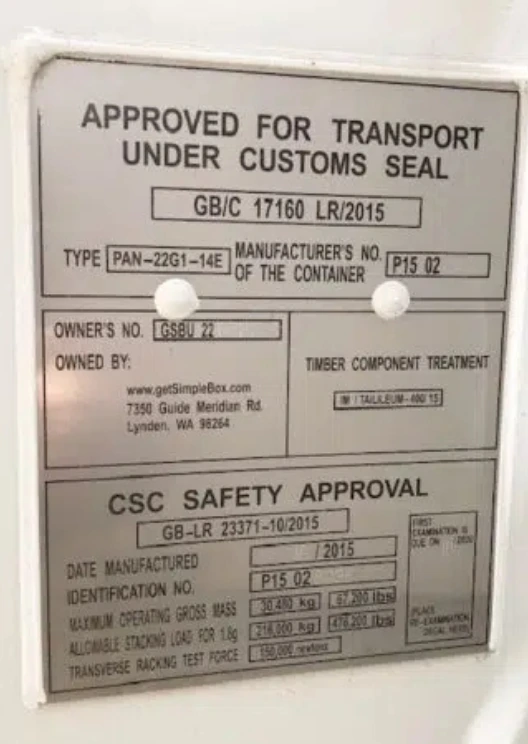
Every shipping container is fitted with a CSC (Convention for Safe Containers) plate, which certifies that the container meets international safety standards. The plate shows details such as the container’s manufacturer, date of production, maximum gross weight, and stacking capabilities. This plate is required for containers used in international transport.
Certification & Surveying
 Certification & Surveying
Before being put into service, containers undergo certification and surveying to confirm they meet ISO (International Organization for Standardization) standards. Surveys may be required throughout a container’s lifespan for continued use in shipping. Certified containers are labeled as cargo-worthy, while others may be reclassified for storage-only purposes.
MGW or Max Gross Weight
 MGW or Max Gross Weight
The Max Gross Weight (MGW) is the maximum total weight a container can safely carry, including its own empty weight plus cargo. For example, a standard 20ft container typically has an MGW of about 67,200 lbs (30,480 kg). This rating ensures containers are not overloaded, which could compromise safety during transport or stacking.
What Condition or Grades of Shipping
Containers are there?


What are the Differences between Shipping
Containers?
HC / HIGH-CUBE / HI-CUBE Container
This container has either a hard plastic or softer tarp covering the roof of the container. >>
DV / Dry Van Containers
Often simply called Dry Van, but should not be confused with a van body or cargo trailer with wheels. >>
FR or F/R or Flat Rack Container
A Flat Rack is designed with no roof or side walls and a collapsible end wall. >>
OT or O/T or Open Top Container
This container has either a hard plastic or softer tarp covering the roof of the container, making it more like a dump-truck body.>>
OS or Open Side Shipping Container
Some containers are available with curtains instead of steel side walls, while others are sold with doors along the side.>>

All ABout Container Conditions

Container condition is just as important as size when choosing the right shipping container. Whether you need a brand-new one-trip container for maximum lifespan, a wind and water tight unit for secure storage, or a cost-effective used container, knowing the available condition options helps you match the right container dimensions to your budget and project.

20ft Container Dimensions
20-foot Shipping Container is our most popular size. Perfect for moving, renovation, or job site storage. Our Loaded Moves use 20ft Containers, 33% larger than typical Moving Containers.
40ft Container Dimensions
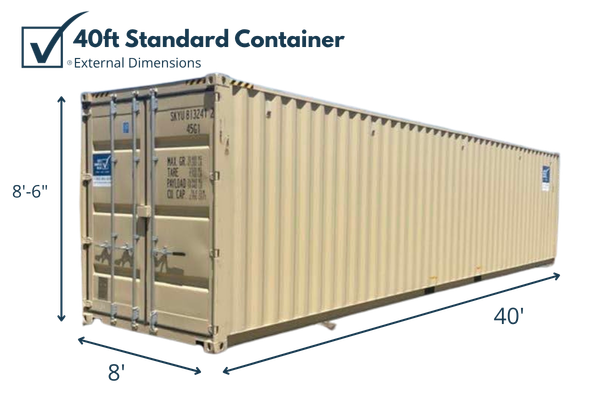
The 40 foot shipping container offers secure, weatherproof storage for businesses, job sites, and personal use. Built to withstand harsh conditions, it’s a durable storage solution.
10ft Container Dimensions
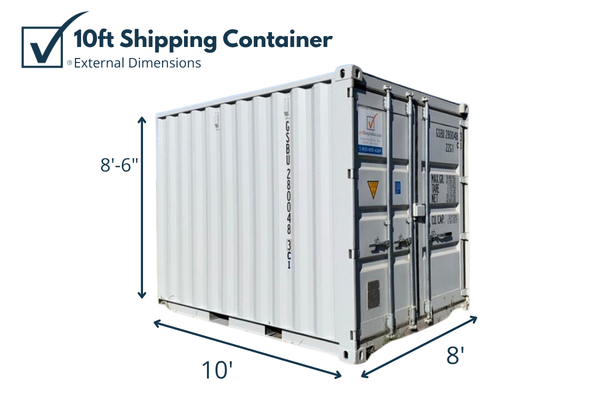
Looking for a small shipping container that still provides excellent security and convenience? A 10 foot shipping container might be the perfect option for you.
Understanding Container Dimensions: FAQs
What sizes of containers do you offer?
What sizes do shipping containers come in?
What sizes do portable storage containers come in?
What is a 7-foot storage container?
Short Answer: It’s a compact “mini” container that’s easier to fit in smaller spaces. Full Answer: A 7-foot storage container is a smaller option designed for tighter spaces and lighter storage needs. It’s great for backyard storage, pump houses, well houses, and tight properties.
What are the dimensions of a 7-foot storage container?
Short Answer: It’s about 8’ long, 8’ wide, and 9’6” tall (High Cube height). Full Answer: Our small “7-foot” container is approximately 8 feet long, 8 feet wide, and about 9 feet 6 inches tall. It includes full cargo doors, a lockbox, and a thick rubber door gasket.
What is a 10ft shipping container used for?
It is ideal for tight driveways, small residential moves, or minor decluttering projects where a standard 20-foot container will not fit.
How big is a 10ft container?
A standard 10ft container is approximately 10 feet long, 8 feet wide, and 8 feet 6 inches tall.
Can I rent a 10ft container?
Lorem ipsum dolor sit amet, consectetur adipiscing elit. Ut elit tellus, luctus nec ullamcorper mattis, pulvinar dapibus leo.
Do 10ft containers come in different types?
Yes, 10ft container rentals are available at many of our locations for small moves or tight spaces.
Can a 10ft container be delivered to my home?
Absolutely. Because of its smaller footprint, it is one of the easiest containers to deliver to residential driveways.
Can I use a 10ft container for business or retail use?
Yes, they are perfect for storing extra retail inventory, file boxes, or tools at a commercial job site without taking up too much parking space.
What types of 20ft containers do you offer?
We offer standard 20ft containers, 20ft High Cubes, 20ft double-door containers, and modified 20ft units depending on local inventory.
What Kind of Doors Do 20ft Containers Have?
Standard 20ft containers feature heavy-duty, weather-tight cargo doors on one end. We also offer double-door models with cargo doors on both ends, and can install custom roll-up doors.
How much can I store in a 20ft container?
A standard 20-foot container typically holds the contents of a 2 to 3 bedroom home, making it our most versatile size.
What are the dimensions of a 20-foot container?
Short Answer: A standard 20-foot container is 20’ long, 8’ wide, and 8’6” tall. Full Answer: A 20-foot container is 20 feet long, 8 feet wide, and about 8 feet 6 inches tall. It’s one of the most common and versatile sizes for both rentals and purchases.
What is the Weight Capacity for a 20-foot Container?
The average weight of goods from a 3-bedroom home is around 6,500 lbs. We allow up to 9,000 lbs for free, with an overweight fee of $75 per 1,000 lbs, up to a maximum of 12,000 lbs for safe transport.
How much does a 20-foot container weigh?
Short Answer: A typical 20-foot container weighs about 4,900 pounds. Full Answer: A standard 20-foot steel shipping container typically weighs about 4,900 pounds. This is important to know if you’re placing it on softer ground.
What are 40ft shipping containers used for?
They are ideal for large commercial storage, agricultural equipment, extensive home remodels, or moving a 4-to-5 bedroom home.
What types of 40ft containers do you offer?
We generally offer standard 40ft containers and 40ft High Cube containers for extra vertical clearance.
What are the dimensions of a 40-foot container?
Short Answer: A standard 40-foot container is 40’ long, 8’ wide, and 8’6” tall. Full Answer: A 40-foot container is 40 feet long, 8 feet wide, and about 8 feet 6 inches tall.
How big is a 40ft container?
It measures 40 feet in length, 8 feet in width, and 8 feet 6 inches in height.
How much does a 40-foot container weigh?
Short Answer: A typical 40-foot container weighs about 8,200 pounds. Full Answer: A standard 40-foot steel shipping container typically weighs about 8,200 pounds. This is helpful to know if placing on soft ground.
What is a “High Cube” container?
Short Answer: A High Cube container is one foot taller than a standard container. Full Answer: High Cube containers are about 9 feet 6 inches tall (instead of 8 feet 6 inches).
When should I choose a High Cube container?
Short Answer: Choose High Cube if you need extra height for equipment, shelves, or working space. Full Answer: High Cube containers are recommended when you need to drive taller equipment inside, store taller items, stack higher pallets, or work inside.
What is a double-door container?
Short Answer: A double-door container has full cargo doors on both ends. Full Answer: A double-door container has standard cargo doors on both ends of the container instead of just one end.
Why would someone want a double-door container?
Short Answer: It gives you easy access from either end and makes organizing much easier. Full Answer: Double-door containers are a great choice for customers who want better access, easier inventory management, or the ability to load/unload without digging through the entire container.
What does “DV / Dry Van” mean?
Short Answer: It’s a standard shipping container (not refrigerated or specialty). Full Answer: “Dry Van” is the standard type of shipping container used for general cargo. This is the most common container type used for storage, rentals, and basic purchases.
Do you offer refrigerated containers (reefers)?
Short Answer: Sometimes—availability depends on location and inventory. Full Answer: Refrigerated containers (often called “reefers”) are specialty containers used to maintain cold temperatures. They aren’t always in stock, but we can sometimes source them.
Which size container should I start with?
Short Answer: Most customers start with a 20-foot container because it’s the most versatile size. Full Answer: A 20-foot container is usually the best starting point because it’s versatile, fits in many driveways, and works well for residential storage.
What is the difference between a shipping container and a conex box?
Short Answer: They’re basically the same thing—just different terms people use. Full Answer: “Conex” originally referred to military storage containers, while “shipping container” is the broader term used worldwide. In normal conversation, they mean the same thing.
What are shipping containers made of?
Shipping containers are constructed from high-quality, durable Corten steel. This “weathering steel” is specifically designed to resist rust and withstand harsh oceanic travel and extreme weather.

Knowing the right storage container dimensions is key to choosing the perfect fit for your home, business, or job site. Whether you’re comparing 10ft, 20ft, or 40ft shipping containers, understanding container sizes and capacities ensures your belongings stay secure and accessible. Below, we answer common questions about storage container dimensions, helping you make an informed choice for any project or storage need.