“If you don’t like where you are, move. You are not a tree.” — Jim Rohn
Sometimes moving means taking your belongings to a new home. Other times, it means moving the shipping container itself.
Whether you’ve purchased a container and need it delivered to your property, are relocating it to a new job site, or need to move it from one property to another, container relocation takes more than just a truck. It takes the right equipment, a clear path, and a few important checks before moving day.
At Get Simple Box, we’ve been helping customers with shipping containers since 1997. This guide explains how container relocation works, what you’ll need to prepare, and what to expect throughout the process.
The short version: Send us your pickup and delivery addresses along with a few photos of the container and both locations. We’ll review the information, provide a quote, and coordinate the move.
What Is Container Relocation?
Container relocation is the process of transporting an existing shipping container from one location to another. It typically requires specialized hauling equipment, a suitable container, clear access at both locations, and a qualified transport provider.

Can I Move a Shipping Container Myself?
It is possible, but it isn’t simple. Shipping containers are heavy and require specialized equipment to load, transport, and unload safely.
Two common transportation methods include:
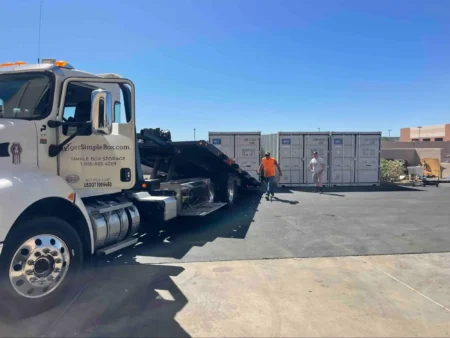
- Tilt-bed trailer: The truck bed tilts backward so the container can slide on and off. The truck needs enough room to maneuver and sufficient overhead clearance when the bed is tilted.
- Flatbed trailer: The container is lifted onto and off the trailer using specialized lifting equipment, such as a crane or container-capable forklift.
You’ll also need to consider licensing, insurance, equipment, site access, and properly securing the container for transportation.
Because of these requirements, many container owners choose to work with an experienced transportation provider rather than coordinate the equipment and logistics themselves.
Container Relocation at a Glance
- Can a shipping container be moved? Yes. Most shipping containers can be relocated if they are in suitable condition and the site is accessible.
- Can you move a loaded container? Get Simple Box can relocate qualifying loaded 20-foot containers up to 9,000 pounds at our standard rate. Loads up to 12,000 pounds may be possible for an additional fee. 40-foot containers must be empty.
- What equipment is used? Depending on the container and circumstances, a tilt-bed or flatbed truck may be used.
- What affects the cost? Container size, distance, site access, weight, and time required.
- What do I need to get a quote? Pickup and delivery addresses, container size, loaded or empty status, and photos of the container and both locations.
Container Relocation, Step by Step
Step 1: Tell Us What You Need
Start by sharing a few basic details:
- Pickup address (where the container is now)
- Delivery address (where you want it placed)
- Container size (20-foot or 40-foot)
- Whether the container is empty or loaded
- Who will be on site at both locations
You can send the information by email or phone. The more details you provide upfront, the easier it is to evaluate the move.
Step 2: Confirm You Own the Container
You must own the container or have written permission from the owner to relocate it.
If you purchased the container, let us know where and approximately when. If you’re in the process of purchasing it, let us know that as well.
Step 3: Send Photos or a Short Video
Photos help us understand what the driver will encounter at both locations.
Please send three or four photos, or a short video, showing:
- The front, back, and both sides of the container
- A close-up of the bottom corner castings near the doors
- The approach from the road to the container
- Whether the container is sitting on blocks or directly on the ground
We’ll review the photos before scheduling the move. This helps identify potential problems before a truck is dispatched.
Step 4: Check the Container’s Condition
The container needs to be ready for transportation.
We’ll look for:
- Standard corner castings: These are the steel fittings at each corner where lifting and securing equipment connects.
- Solid side rails: No significant structural damage, severe rust, or holes.
- No attached items: Wheels, lights, shelves, overhangs, decks, lean-tos, solar panels, and signs may interfere with transportation and need to be removed.
- A clear roof: Remove moss, standing water, and debris before transportation.
Not sure about your container’s condition? Read our guide to shipping container grades and conditions.

Step 5: Tell Us About the Weight
The container’s weight and contents affect how it can be transported.
- 20-foot containers: Loaded containers up to 9,000 pounds can be moved at our standard rate. Loads from 9,000 to 12,000 pounds may be possible for an additional fee. We cannot move a loaded 20-foot container over 12,000 pounds.
- 40-foot containers: Must be completely empty. We do not move loaded 40-foot containers.
If your container is loaded, tell us what is inside and provide your best estimate of the total weight. Heavy items such as safes, pianos, and machinery are especially important.
If you’re unsure about the weight, just let us know. It’s better to discuss it before moving day.
Step 6: Make Sure Both Locations Are Ready
Your container needs a safe path at both locations: where it is now and where it is going.
Please check for:
- Firm, solid ground: The container cannot be buried, sunk, or blocked in.
- Width: Plan for at least 13 feet of width.
- Overhead clearance: Plan for at least 15 feet of overhead clearance.
- Straight approach: Plan for 70 feet for a 20-foot container. For a 40-foot container, at least 120 feet is needed, with 140 feet preferred.
- Potential hazards: Look for overhead wires, low branches, slopes, septic systems, and other obstacles.
A quick walk from the road to the container’s location with your phone camera recording can be a big help.
Remember, a driveway that works for a passenger vehicle may not provide enough room for a truck transporting a shipping container.

Step 7: Tell Us If You Want the Doors Turned
Think about how you plan to use the container after it arrives.
Do you need the doors facing a different direction? In many cases, we can turn the container during placement. This is determined case by case and involves an additional fee.
Let us know your preferred door orientation when requesting a quote so we can plan accordingly.
Step 8: Get Your Quote and Pay the Dispatch Fee
Once we have your photos and information, we’ll prepare a quote based on container size, mileage, and time.
The quote includes 15 minutes on site at each stop. Additional time is billed separately.
Before we dispatch a driver, a dispatch fee is collected. The dispatch fee is equal to the delivery fee for your move.
Here’s how it works:
- If the move is completed, the dispatch fee is applied toward your total.
- If the driver arrives but cannot complete the move because of site conditions that were not disclosed beforehand, the dispatch fee is not refunded.
Why do we do it this way? When we didn’t originally deliver the container, there can be unknowns involving ground conditions, access, and the container itself. Good photos and honest answers help prevent surprises.
You’ll also receive a copy of our hold harmless agreement to review. You do not need to sign it.
You can review our Terms & Conditions at any time.
Step 9: Moving Day
Here’s what to expect when the driver arrives:
- Driver notification: Your driver will send a text when they’re on the way.
- Site walkthrough: We call it G.O.A.L.: Get Out And Look. The driver checks the path for wires, branches, slopes, soft ground, and other obstacles.
- Container inspection: The driver checks the corners, rails, roof, and anything that could interfere with transportation.
- Before photos: Photos document the container’s condition before loading.
- Loading and securing: The container is loaded and secured with straps or chains.
- Destination walkthrough: The driver checks the new location before placing the container.
- Careful placement: The driver positions the container, places blocks as needed, and checks that it is level.
- Door check: The driver makes sure the doors open and close properly.
- After photos: Photos document the container in its new location.
Having someone familiar with the move available at both locations helps everything go smoothly.
Your Container Relocation Checklist
Use this checklist to prepare before requesting a quote:
- ☐ I own the container or have written permission from the owner.
- ☐ I have the pickup and delivery addresses.
- ☐ I know the container size.
- ☐ I know whether the container is empty or loaded.
- ☐ If it’s a 40-foot container, it is completely empty.
- ☐ If it’s a loaded 20-foot container, I know what’s inside and have an estimated weight.
- ☐ Nothing is attached that could interfere with transportation.
- ☐ The roof is clear of moss, water, and debris.
- ☐ I have photos of the front, back, and both sides.
- ☐ I have a close-up photo of the bottom corner castings.
- ☐ I have photos or video of the approach from the road.
- ☐ I know whether the container sits on blocks or directly on the ground.
- ☐ Both locations have firm ground, at least 13 feet of width, and 15 feet of overhead clearance.
- ☐ Both locations have sufficient straight approach and working room.
- ☐ I’ve checked for wires, branches, slopes, and septic systems.
- ☐ Someone will be available at both locations.
- ☐ I know which direction I want the doors to face.
Container Relocation FAQ
How much does it cost to move a shipping container?
The cost depends on the container size, distance, and time required. We prepare a quote after reviewing your addresses, photos, and relocation details.
Request a shipping container quote.
Can you move a loaded shipping container?
Yes, in some cases. Loaded 20-foot containers up to 9,000 pounds can be moved at our standard rate. Loads from 9,000 to 12,000 pounds may be possible for an additional fee. We cannot move a loaded 20-foot container over 12,000 pounds. A 40-foot container must be completely empty.
Can you move a container I purchased from another company?
Yes. We can review relocation requests for containers purchased elsewhere. The container must meet our transportation requirements, and you must own it or have permission from the owner to move it.
Can you move a container with wheels, lights, or shelves attached?
Anything attached that could interfere with loading, securing, or transportation must be removed before the move. This includes wheels, lights, shelves, decks, awnings, and other attachments.
Can you turn the container so the doors face a different direction?
In many cases, yes. It depends on the equipment and site conditions, and an additional fee applies. Let us know when requesting your quote.
What happens if the driver cannot complete the move?
If the driver cannot complete the move because of site conditions that were not disclosed beforehand, the dispatch fee is not refunded. If the move is completed, the dispatch fee is applied toward your total.
How much room does the truck need?
Plan for at least 13 feet of width and 15 feet of overhead clearance at both locations. The truck also needs sufficient straight approach and working room: 70 feet for a 20-foot container and at least 120 feet for a 40-foot container, with 140 feet preferred.
Do I need to be there on moving day?
Someone familiar with the move should be available at both the pickup and delivery locations. We’ll confirm your delivery contacts when scheduling.

Ready to Move Your Shipping Container?
At Get Simple Box, we’re committed to helping people move to a better place.
As Ross Black, CEO of Get Simple Box, puts it:
“One thing that I love about working at Get Simple Box is that each day we get to help move people to a better place.”
That purpose extends beyond moving household belongings. Sometimes it’s helping a business relocate equipment, giving a property owner more flexibility, or helping someone get a shipping container exactly where it needs to be.
If you need to relocate a shipping container, send us your pickup and delivery addresses along with a few photos. A real person on our team will review the details and help you understand the next steps.
Request a Shipping Container Relocation Quote
Have questions? Contact Get Simple Box or call 1-855-855-4269.
Want to learn more about what happens when we deliver a container? Read Container Delivery 101: What to Expect.