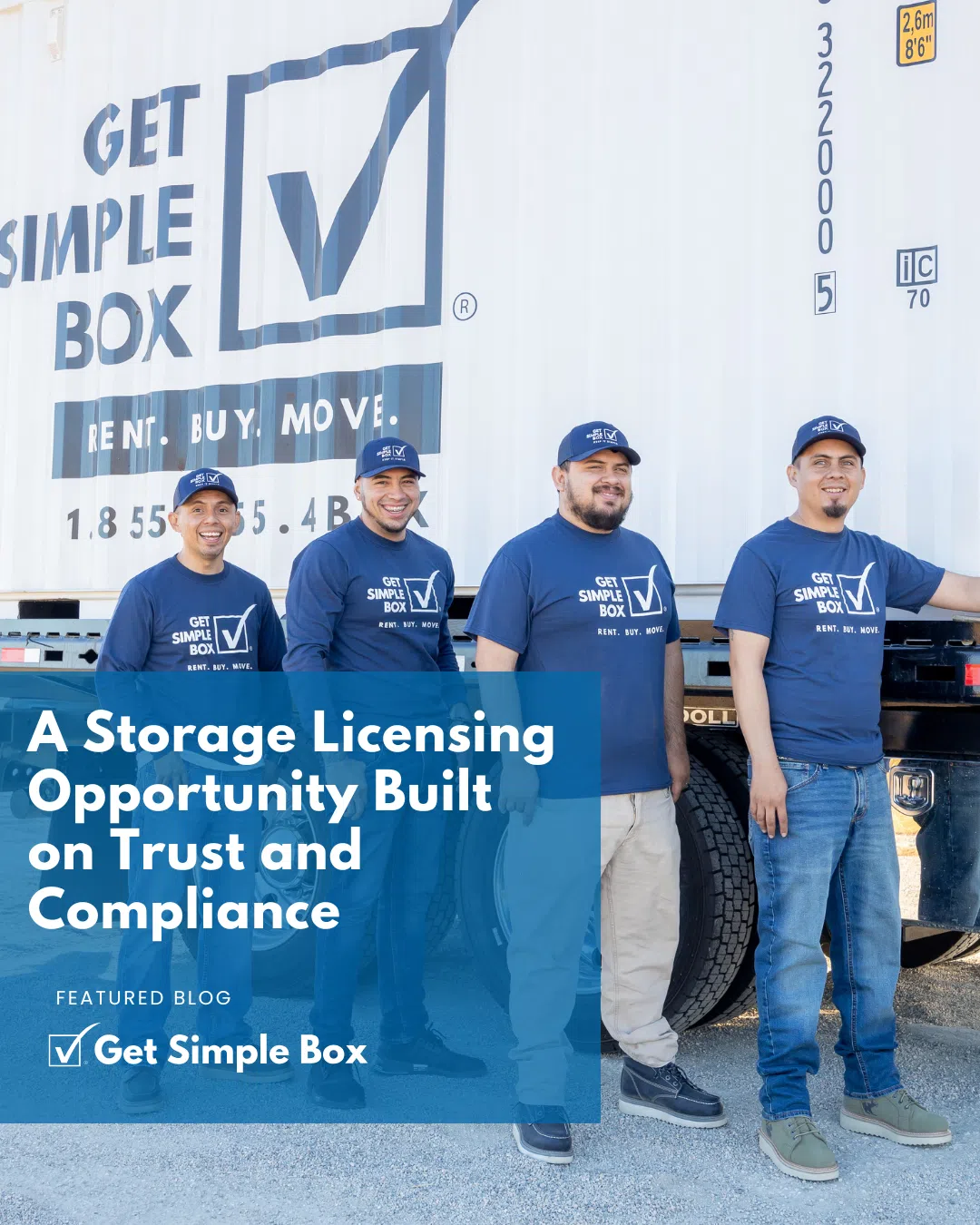
A Storage Licensing Opportunity Built on Trust and Compliance
If you’re exploring a storage licensing opportunity, chances are you’re not just looking for a business, you’re looking for independence. You want to build something you own, serve your community well, and create real value without being boxed in by rigid rules or corporate control.
Here’s the problem: most options force an annoying trade-off. Either you buy into a franchise and give up freedom (plus pay big fees), or you go fully DIY and spend years learning the hard way. This guide is for people who want a better path, a storage licensing opportunity built on trust and compliance, where you keep ownership and control while getting the support that actually makes a difference.
This guide breaks down what actually makes a storage company easy to work with, how common options like PODS®, mini storage, and national container brands compare, and what to look for if you want storage that fits your life instead of disrupting it.
Table of Contents
Quick Answer: What a Storage Licensing Opportunity Really Offers
A storage licensing opportunity is a way to build and own your own storage-container business using a proven brand and support platform, without franchise fees, ongoing royalties, or heavy-handed control. In plain terms, you’re the owner, you run the operation, and you get tools that help you launch faster and compete more effectively.
With Get Simple Box, licensing is designed for operators who want full ownership with support that feels practical, not performative. That includes territory planning, a proven delivery approach, marketing guidance, and access to supply chain advantages that can be hard to build alone.
A storage licensing opportunity gives you independence with support, so you can launch with confidence, avoid expensive mistakes, and build a local business you can grow and eventually sell.
Why Independence Matters More Than a Big Brand Name
If you’re researching storage licensing opportunities, you’ve probably already realized something important: a brand name alone doesn’t run a business. What actually drives success is service speed, customer experience, consistent local marketing, and operations that hold up when things get busy.
That’s why a franchise isn’t automatically the “safe” choice it’s often made out to be. Many franchise systems come with high upfront fees, ongoing royalties, required vendors, and rigid rules that don’t always translate well to real-world local markets.
Independence isn’t just a personal preference, it’s a competitive advantage when it’s paired with the right support. Local ownership means faster decisions, stronger customer relationships, and the freedom to adjust pricing, processes, and sales strategies to fit your market without waiting on corporate approval.
Pro Tip: When evaluating any storage licensing opportunity, ask how many decisions you’ll still control after you open. If pricing, vendors, marketing spend, or service offerings are locked in, you may be buying a brand, but losing the flexibility that actually drives local profitability.

Storage Licensing Opportunity vs Franchise vs DIY
Most people comparing a storage licensing opportunity are trying to answer one question: “Is licensing actually better than a franchise, or am I safer going DIY?” That’s a smart question, because the wrong structure can make a good business feel heavier than it needs to be.
Here’s the clear breakdown. Franchising often trades independence for a brand name and charges you for it, DIY protects your freedom but costs you time and mistakes, and licensing is meant to give you independence plus a proven foundation.
Comparison Table: Licensing vs Franchising vs DIY
Feature | Get Simple Box Licensing | Start From Scratch (DIY) | |
Brand use | Yes (trusted brand) | Yes | No (you build it) |
Territory rights | Yes (defined options) | Yes (strict) | No (open) |
Franchise fee | None | Often $20k–$50k+ | None |
Royalties | None | Ongoing monthly % | None |
Operational freedom | High | Low | High |
Systems required | Optional (recommended) | Mandatory | You create everything |
Support | Operator-focused | Corporate-style | None unless hired |
Exit flexibility | High | Often limited | Depends on you |
If you’re a values-driven owner who wants to build something local, licensing is often the sweet spot. It helps you avoid the “pay-to-play” structure of franchising without forcing you to reinvent everything from scratch.
Serving Real Local Needs With Portable Storage Licensing
Portable storage isn’t a trend, it’s a practical service that solves real problems every day. People don’t wake up excited to buy storage; they wake up needing space, speed, and a simple solution they can trust.
A portable storage licensing model works because customers want storage delivered to their driveway or jobsite, with clear pricing and a real person who answers the phone. When service is local, response times tend to be faster and the experience feels more human.
Local markets create repeatable demand across many customer types. Homeowners remodel, families move, contractors rotate job sites, and businesses constantly manage overflow inventory, making portable storage a steady, year-round service rather than a one-time need.
Local use cases (what customers hire you for)
Portable storage usually shows up in a few predictable scenarios. These are the “money moments” in a market where speed and reliability matter most:
- Home remodels and renovations (short-term storage at home)
- Local moves and transitions (temporary storage + logistics)
- Contractors and job sites (secure onsite storage)
- Small business overflow (inventory, equipment, seasonal storage)
- Life transitions (downsizing, inheritance, divorce, relocation)

What You Actually Sell: Rent Storage Containers, Sell Shipping Containers
A Get Simple Box location is built around more than a single service. Instead of relying on just one revenue stream, operators offer a mix of storage and logistics solutions that serve both residential and commercial customers. This diversified approach helps the business stay steady across seasons and changing local demand.
At its core, operators rent storage containers, sell shipping containers, and provide professional delivery and logistics. In many markets, locations also support moving solutions and ownership-based upgrades that meet longer-term or specialized customer needs.
Storage Container Rentals
Storage container rentals serve customers who need secure space without a long-term commitment. Containers are delivered directly to homes, job sites, or businesses, making storage more convenient than traditional self-storage facilities.
Rentals are commonly used during remodels, temporary projects, and transitions. Because these needs happen year-round, rentals tend to create consistent demand in most local markets.
Shipping Containers for Sale
Some customers prefer to own rather than rent. Offering shipping containers for sale provides a long-term solution for storage, workspace, or property use.
Ownership appeals to contractors, businesses, and landowners who want a durable asset they can use over time. Having both new and used options allows customers to choose based on budget and intended use.
Sizes, Options, and Flexibility
Customers come to portable storage with different space needs depending on their situation. Having clear, straightforward size options makes it easier for them to choose a solution that fits their project without overcomplicating the decision.
In most markets, demand centers around:
- 10′ containers for small projects and tight spaces
- 20′ containers as the most common all-around option
- 40′ containers for larger storage needs and job sites
Steel shipping containers, especially 20′ and 40′, also provide significantly more usable space than many typical portable storage units, which matters when customers are storing a full household, tools, or business inventory. That added space often helps customers feel confident they’re choosing the right option.
Moving & Logistics Support
Many locations also support portable storage and moving solutions. Customers can pack on their own schedule, while the local team coordinates transportation and delivery.
This approach appeals to customers who want flexibility and less pressure during a move. For operators, it adds another way to serve local needs without running a separate type of business.
Container Modifications (Ownership-Based)
Some customers want more than basic storage. For owned containers, locations may support modifications that allow containers to be used for offices, workshops, or other custom purposes.
Permanent modifications are only performed on containers a customer owns, not on rentals. This clear boundary protects the business, sets expectations early, and reinforces trust throughout the sales process.
Who This Storage Licensing Opportunity Is Built For
A storage licensing opportunity isn’t right for everyone. It’s built for the kind of owner who values freedom, wants a real plan, and is willing to build a reputation one customer at a time.
You’re a fit if you want a clear model, predictable systems, and marketing momentum without losing the ability to adapt locally. You’re also a fit if you want something scalable and sellable, not just a stressful operator job.
Many ideal operators come from service-based businesses, logistics, equipment rental, sales, or operations leadership. What matters most isn’t your resume, it’s your character and your willingness to run a reliable, customer-first business.
Ideal operator traits
- Integrity first (trust is the product)
- Hard working (growth takes consistency)
- Customer-focused (reviews drive momentum)
- Problem solver (deliveries are real life)
- Community-minded (local reputation is the moat)

How Licensing Works: From Territory to Launch
Most opportunity pages stay vague here, so let’s keep it practical. Licensing should feel like a clear path, not a mystery.
Get Simple Box keeps the process straightforward so you know what you’re stepping into. You start with territory fit, you gain access to tools and support, then you launch and serve customers locally.
Step 1: Apply for a territory license
Territory fit matters because portable storage is both local and logistical. You look at population demand, supply access, competition, and whether you have the yard space and zoning needed to operate smoothly.
A basic territory checkpoint often includes a minimum population threshold and a workable location relative to supply routes. The goal is simple: set you up in a market where the model has room to win.
Step 2: Access brand, systems, and marketing tools
You gain brand assets and guidance you can use immediately. You also get operational know-how around delivery, customer expectations, and how to keep the business organized as volume grows.
On the marketing side, you’re not left guessing what to do next. You get a foundation that helps you show up locally, build credibility, and turn visibility into leads.
Step 3: Launch and serve customers in your territory
You open your yard, start delivering, start selling, and build reputation through reliable service. You focus on doing the basics exceptionally well, because that’s what creates a strong local brand.
A quick reality check: the win isn’t perfection on Day 1. The win is having a proven roadmap and support so you avoid the costly mistakes that stall most new operators.
How Licensing Works: From Territory to Launch
Most opportunity pages stay vague here, so let’s keep it practical. Licensing should feel like a clear path, not a mystery.
Get Simple Box keeps the process straightforward so you know what you’re stepping into. You start with territory fit, you gain access to tools and support, then you launch and serve customers locally.
Step 1: Apply for a territory license
Territory fit matters because portable storage is both local and logistical. You look at population demand, supply access, competition, and whether you have the yard space and zoning needed to operate smoothly.
A basic territory checkpoint often includes a minimum population threshold and a workable location relative to supply routes. The goal is simple: set you up in a market where the model has room to win.
Step 2: Access brand, systems, and marketing tools
You gain brand assets and guidance you can use immediately. You also get operational know-how around delivery, customer expectations, and how to keep the business organized as volume grows.
On the marketing side, you’re not left guessing what to do next. You get a foundation that helps you show up locally, build credibility, and turn visibility into leads.
Step 3: Launch and serve customers in your territory
You open your yard, start delivering, start selling, and build reputation through reliable service. You focus on doing the basics exceptionally well, because that’s what creates a strong local brand.
A quick reality check: the win isn’t perfection on Day 1. The win is having a proven roadmap and support so you avoid the costly mistakes that stall most new operators.
Where Storage Licensing Opportunities Are Available Today
Availability matters when you’re researching a storage licensing opportunity, especially if you’re focused on high-growth regions or underserved local markets. Territories are planned intentionally to support strong local operations, which means availability can change as markets are filled and demand shifts.
Current opportunities are concentrated in states where portable storage demand, logistics access, and population growth align well with the model. These markets offer room for local operators to build a presence without being crowded out by oversaturation.
Territories available now include:
- Licensing opportunities in Idaho
- Licensing opportunities in Montana
- Licensing opportunities in Utah
- Licensing opportunities in Texas
- Licensing opportunities in Florida
There is also active interest in surrounding and adjacent markets, including licensing opportunities in Nevada, as territory planning continues to evolve. Availability depends on factors like market size, proximity to existing locations, and overall coverage strategy.
If you’re searching for business ownership opportunities near me and don’t see your state listed, that doesn’t automatically mean it’s off the table. The best next step is to start a conversation, since new territories can open as the network expands and markets are evaluated.
Competitor Comparison: PODS + Local Options (Why Local Wins)
If you’re evaluating a storage licensing opportunity, you’re also thinking, “How do I compete with PODS or big national brands?” That’s a fair concern, and it’s one reason people avoid DIY.
The good news is you don’t beat a call center by acting like one. You win by being local, fast, flexible, reliable, and by having marketing systems that help you show up where customers search.
Comparison Table: Get Simple Box vs PODS (Operator Perspective)
Category | PODS (National Call-Center Model) | |
Response time | Local, fast decision-making | Slower, layered approvals |
Delivery flexibility | Higher (local scheduling) | More standardized windows |
Customer experience | Personal, community-based | Centralized, less personal |
Local SEO & reviews | Built around local reputation | National brand, mixed local signals |
Service differentiation | Relationship + reliability | Scale + standardization |
Why local wins
Local operators can deliver faster, solve problems in real time, and build a reputation customers actually remember. When you combine that with strong local marketing, you don’t need to “outspend” a national brand, you need to out-serve them.
This is also why the right low cost business ownership opportunity can still be compelling. When your business is built on service and local trust, your reputation becomes a moat competitors can’t copy.

How Do You Start a Storage Licensing Opportunity? (FAQs and Straight Answers)
1) What does it mean to open a Get Simple Box location?
It means you operate your own local business using Get Simple Box brand support and tools while keeping ownership and control of operations. You’re building your business, not managing someone else’s rules.
2) Is this a franchise?
No. Get Simple Box operates as a licensing model, not a franchise. That means no franchise fees, no revenue-based royalties, and more flexibility.
3) Do I keep my company name?
In many cases, yes. Co-branding can be an option, which lets owners keep their local identity while leveraging the trusted Get Simple Box name.
4) What do customers actually buy from me?
Customers rent storage containers for temporary storage and buy shipping containers for ownership. Many operators also add delivery services that fit their local market.
5) Can I offer container modifications?
Yes, especially for owned containers. Permanent modifications should be done only on containers the customer owns, not on rentals.
6) How long does it take to get started?
Timelines depend on territory, yard readiness, equipment, and inventory. The process is designed to be straightforward: territory → tools → launch.
7) Where are territories available right now?
Current focus includes Idaho, Montana, Utah, Texas, and Florida, with other areas under evaluation. If you’re exploring storage licensing opportunities elsewhere, ask, territory planning changes.
Conclusion: Building Something Local, Lasting, and Yours
If you’ve been researching a storage licensing opportunity because you want independence, a proven model, and a business you can build long-term, you’re asking the right questions. The goal isn’t just to “start”, it’s to build something stable, scalable, and respected in your community.
A storage licensing opportunity built on trust and compliance is for owners who want freedom with real support. You run the business your way, with a team behind you that helps you avoid expensive mistakes and build momentum faster.
Next step: Schedule a no-pressure licensing overview call and see if there’s a territory fit. If you’re ready to explore licensing opportunities in Texas, Florida, Utah, Idaho, Montana, or Nevada, we’ll walk through the details plainly, no hype, no pressure, just clarity.
Website: getsimplebox.com/licensing
Phone: 561-571-5810
Brand promise: Local • Professional • Kind
Related Posts:
A Storage Licensing Opportunity Built on Trust and Compliance
A Storage Licensing Opportunity Built on Trust and Compliance If you’re exploring a storage licensing opportunity, chances are you’re not

How We Train Drivers for Safe, Reliable Container Delivery in Youngtown, AZ
How We Train Drivers for Safe, Reliable Container Delivery in Youngtown, AZ After you’ve chosen whether to rent a storage

What Makes a Storage Company Easy to Work With
What Makes a Storage Company Easy to Work With Choosing a storage company shouldn’t feel harder than the move, remodel,
4 Things to Look for in the Best Storage Company in Indian Wells, CA
4 Things to Look for in the Best Storage Company in Indian Wells, CA When people start looking for a

Conex Box in Bothell, WA: Grades, Container Sizes, Dimensions & Modification Options
Conex Box in Bothell, WA: Grades, Container Sizes, Dimensions & Modification Options If you’re looking for a conex box in

How We Train Drivers for Safe, Reliable Container Delivery
How We Train Drivers for Safe, Reliable Container Delivery When you are waiting for your storage container delivery, you’re not